Soto Zen

Sōtō Zen or the Sōtō school (曹洞宗 Sōtō-shū) is the largest of the three traditional sects of Zen in Japanese Buddhism (the others being Rinzai and Ōbaku). The Japanese Sōtō-shū is based on the teachings of the Chinese Caodong zong, a branch of the Chinese Chan school which was founded during the Tang dynasty by Dongshan Liangjie. The Caodong teachings were brought to Japan by the Japanese master Dōgen Zenji. Dōgen had traveled to China and studied with Caodong masters before returning to Japan circa 1227 and beginning to transmit the teachings.
Dōgen is remembered today as the ancestor of Sōtō Zen in Japan along with Keizan Jōkin.[1][2]
Sōtō Zen is now also popular in the West, and in 1996 priests of the Sōtō Zen tradition formed the Soto Zen Buddhist Association based in North America.
History
Chinese origins

The Japanese Sōtō-shū is based on the teachings of the Chinese Caodong zong which were brought to Japan by Dogen in 1227.
The Caodong zong is one of the five houses of Chan, which traces its linage back to Huineng, the sixth patriarch of Chan, via his purported students Qingyuan Xingsi and Shitou Xiqian. But its history actually begins with the two Tang-dynasty Chan masters who lend their names to the school: Dongshan Liangjie (807-869) and his heir Caoshan Benji (840-901).[3] The name "Caodong" is derived from the first characters of these two patriarchs: cao and dong.[3]
The Princeton Dictionary states:
- One of the emblematic teachings of the Caodong tradition is that of the “five ranks” (wuwei), taught by Dongshan and further developed by Caoshan, which was a form of dialectical analysis that sought to present the full panoply of Mahāyāna Buddhist insights in a compressed rubric. During the Song dynasty, the Caodong school also came to be associated with the contemplative practice of “silent illumination” (mozhao chan), a form of meditation that built upon the normative East Asian notion of the inherency of buddhahood (see tathāgatagarbha) to suggest that, since enlightenment was the mind’s natural state, nothing needed to be done in order to attain enlightenment other than letting go of all striving for that state. Authentic Chan practice therefore entailed only maintaining this original purity of the mind by simply sitting silently in meditation.[3]
Kamakura period (1185–1333)

Dōgen Zenji
Dōgen Zenji was originally ordained as a monk in the Tendai School in Kyoto, but he was ultimately dissatisfied with the Tendai teachings and traveled to China to seek out further teachings. He remained in China for four years, finally training under Tiantong Rujing, an eminent teacher of the Caodong lineage of Chinese Chan. Upon his return to Japan, Dōgen began promoting the practice of zazen (sitting meditation) through literary works such as Fukanzazengi and Bendōwa.
Dōgen eventually broke relations completely with the powerful Tendai School, and, after several years of likely friction between himself and the establishment, he left Kyoto for the mountainous countryside where he founded the monastery Eihei-ji in 1243, which remains the head temple of the Sōtō school today.
Dōgen is known for his extensive writing including the Shōbōgenzō (Treasury of the True Dharma Eye, considered his magnum opus), the Eihei Kōroku (Extensive Record, a collection of his talks), Japanese poetry, commentaries, and the Eihei Shingi, the first Zen monastic code written in Japan.
At the monastery he founded, daily routine was based on the Chinese practices, which went back to the Indian tradition:
The elements of Sōtō practice that contributed most to the success of the school in medieval Japan were precisely the generic Buddhist monastic practices inherited from Sung China, and ultimately from India. The Sōtō Zen style of group meditation on long platforms in a sangha hall, where the monks also took meals and slept at night, was the same as that prescribed in Indian Vinaya texts. The etiquette followed in Sōtō monasteries can also be traced back to the Indian Vinaya.[4]
Koun Ejō

Dōgen was succeeded around 1236 by his disciple Koun Ejō (1198–1280).[5][6]
Ejō started his Buddhist studies at Mount Hiei, the center of Tendai studies. Following his stay there he studied Pure Land Buddhism under Shōkū.[7]
Ejō then became a follower of the Darumashū, an early Japanese Zen sect established by Dainichi Nōnin.[8] He studied the Darumashū teachings with a disciple of Nōnin named Kakuan.[7]
Ejō then joined Dōgen in 1229.[9]
Ejō, like Dōgen, believed in the primacy of Zen Buddhism. He resisted efforts from outside to water down the tradition with other beliefs.
Tettsū Gikai

A large group from the Daruma school under the leadership of Ekan joined the Dogen-school in 1241,[9] after severe conflicts with the Tendai and Rinzai schools.[7] Among this group were Tettsū Gikai, Gien and Giin, who were to become influential members of Dōgen's school.[9]
After the death of Ejō, a controversy called the sandai sōron occurred. In 1267 Ejō retired as Abbot of Eihei-ji, giving way to Gikai, who was already favored by Dogen. Gikai too originally was a member of the Daruma school, but joined Dōgen's school in 1241, together with a group from the Nōnin school led by Ekan. Gikai introduced esoteric elements into the practice:
[W]ith the premature death of Dōgen the group lost its focus and internal conflicts led to a split. Dōgen's followers soon introduced such esoteric elements as prayers and incantations into the teaching.[10]
Opposition arose, and in 1272 Ejō resumed the position of abbot. After his death in 1280, Gikai became abbot again, strengthened by the support of the military for magical practices.[11] Opposition arose again, and Gikai was forced to leave Eihei-ji, and exiled to Kaga Province, Dajō-ji (in Ishikawa Prefecture). He was succeeded by Gien, who was first trained in the Daruma-school of Nōnin. His supporters designated him as the third abbot, rejecting the legitimacy of Gikai.
Keizan

The second most important figure in Sōtō, Keizan, belonged to this dissident branch.[12] Keizan received ordination from Ejō when he was, twelve years old, shortly before Ejō's death[13] When he was seventeen he went on a pilgrimage for three years throughout Japan. During this period, he studied Rinzai, Shingon and Tendai. After returning to Daijō-ji, Keizan received dharma transmission from Gikai in 1294, and established Joman-ji.[13] In 1303 Gikai appointed Keizan as abbot of Daijō-ji,[14] a position he maintained until 1311.[15]
Keizan enlarged the Shingon-temple Yōkō-ji in Ishikawa prefecture, turning it into a Zen monastery in 1312.[15] Thereafter he inherited the Shingon temple Shogaku-ji in 1322, renaming it Sōji-ji, which was recognized as an official monastery.[16] In 1324 he put Gasan Jōseki in charge of Sojo-ji, and returned to Yōkō-ji.[16] Yōko-ji was Keizan's main temple, but Sōji-ji thrived better, thanks to Gasan Jōseki[17]
Though today Dōgen is referred as the founder of Sōtō, for a long period Sōtō history recognized several important ancestors, next to Dōgen.[18] In 1877 the heads of the Sōtō community acknowledged Keizan for a brief period as the overall founder of the Sōtō sect.[19]
Dogen is known as the "koso", where Keizan is known as the "taiso";
Both terms mean the original patriarch, that is, the founder of Japanese Sōtō Zen tradition.[20]
Sōtō centers
At the end of the Kamakura period, Dōgen's school centered around four centers, namely Eihei-ji, Daijo-ji monastery, and the temples Yoko-ji and Soji-ji. Soji-ji became the most influential center of the Dōgen school.[15]
Muromachi (or Ashikaga) (1336–1573)
During the Muromachi period the Rinzai school was the most successful of the schools, since it was favoured by the shōgun. But Soto too spread out over Japan.
Gasan and Sotetsu
Gasan Jōseki (1275–1365)[21] and Meiho Sotetsu were Keizan's most prominent students.[21]
Gasan too started his Buddhist studies at mount Hiei.[21] He became head of Soji-ji in 1324.[22] Gasan adopted the Five Ranks of Tung-shan as a fit vehicle to explain the Mahayana teachings.[23]
Sotetsu became head of Yoko-ji in 1325. Initially his influence soon grew. In 1337 Sotetsu was appointed as abbot of Daijo-ji.
Azuchi-Momoyama (1573–1600) and Edo (or Tokugawa) (1600–1868)
After a period of war Japan was re-united in the Azuchi–Momoyama period. Neo-Confucianism gained influence at the expense of Buddhism, which came under strict state control. The power of Buddhism decreased during the Tokugawa period. Buddhism had become a strong political and military force in Japan and was seen as a threat by the ruling clan. Measures were taken to control the Buddhist organisations, and to limit their power and influence.[24] The temple hierarchy system was centralized and unified.[24]
Japan closed the gates to the rest of the world.[25] New doctrines and methods were not to be introduced, nor were new temples and schools. The only exception was the Ōbaku lineage, which was introduced in the 17th century during the Edo period by Ingen, a Chinese monk.[26] The presence of these Chinese monks also influenced the existing Zen-schools, spreading new ideas about monastic discipline and the rules for dharma transmission.[27]
The Sōtō school started to place a growing emphasis on textual authority. In 1615 the bakufu declared that "Eheiji's standards (kakun) must be the rule for all Sōtō monks".[28] In time this came to mean all the writings of Dōgen, which thereby became the normative source for the doctrines and organisation of the Sōtō school.[28]
A key factor in this growing emphasis on Dogen was Manzan's appeal to change the rules for dharma transmission, based on arguments derived from the Shōbōgenzō.[28] From its beginnings, Sōtō-shū has laid a strong emphasis on the right lineage and dharma transmission.[26] In time, dharma transmission became synonymous with the transmission of temple ownership.[29] When an abbot changed position, becoming abbot of another temple, he also had to discard his lineage and adopt the lineage of his new temple.[30] This was changed by Manzan Dokahu (1636–1714), a Sōtō reformer, who ...
[P]ropagated the view that Dharma transmission was dependent on personal initiation between a Master and disciple rather than on the disciple's enlightenment. He maintained this view in the face of strong opposition, citing as authority the towering figure of Japanese Zen, Dōgen ... This became and continues to this day to be the official Sōtō Zen view. [31]
Dōgen scholarship came to a central position in the Sōtō sect with the writings of Menzan Zuihō (1683–1769), who wrote over a hundred works, including many commentaries on Dōgen's major texts and analysis of his doctrines. Menzan promoted reforms of monastic regulations and practice, based on his reading of Dōgen.
Another reformation was implemented by Gentō Sokuchū (1729–1807), the 11th abbot of Eihei-ji, who tried to purify the Sōtō school, de-emphasizing the use of kōans.[32] In the Middle Ages kōan study was widely practiced in the Sōtō school.[33] Gentō Sokuchū started the elevation of Dōgen to the status he has nowadays, when he implemented new regulations, based on Dōgen's regulations.[33]
This growing status of Dōgen as textual authority also posed a problem for the Sōtō school:
The Sōtō hierarchy, no doubt afraid of what other radical reformers might find in Dōgen's Shobo Genzo, a work open to a variety of interpretations, immediately took steps to restrict access to this traditional symbol of sectarian authority. Acting at the request of the Sōtō prelates, in 1722 the government prohibited the copying or publication of any part of Shobo Genzo.[28]
Meiji Restoration (1868–1912) and Imperial expansionism
During the Meiji period (1868–1912) Japan abandoned its feudal system and opened up to Western modernism. Shinto became the state religion, and Buddhism was coerced to adapt to the new regime. Rinzai and Sōtō Zen chose to adapt, with embarrassing consequences when Japanese nationalism was endorsed by the Zen institutions. War endeavours against Russia, China and finally during the Pacific War were supported by the Zen establishment.[34][35]
Within the Buddhist establishment the Western world was seen as a threat, but also as a challenge to stand up to.[34][36] Parties within the Zen establishment sought to modernize Zen in accord with Western insights, while simultaneously maintaining a Japanese identity.[37]
During this period a reappraisal of Dōgen started. The memory of Dōgen was used to ensure Eihei-ji's central place in the Sōtō organisation, and "to cement closer ties with lay people". In 1899 the first lay ordination ceremony was organized in Eihei-ji.[33] Eihei-ji also promoted the study of Dōgen's works, especially the Shōbōgenzō, which changed the view of Dōgen in Sōtō's history.[33] An image of Dōgen was created that suited the specific interests of Eihei-ji:
Dōgen's memory has helped keep Eihei-ji financially secure, in good repair, and filled with monks and lay pilgrims who look to Dōgen for religious inspiration ... the Dōgen we remember is a constructed image, an image constructed in large measure to serve the sectarian agendas of Eihei-ji in its rivalry with Sōji-ji. We should remember that the Dōgen of the Shōbōgenzō, the Dōgen who is held up as a profound religious philosopher, is a fairly recent innovation in the history of Dōgen remembrances.[33]
Spread in the western world
In the 20th century Sōtō Zen spread out to the west.
Shunryū Suzuki
Shunryū Suzuki played a central role in bringing Sōtō to the West. Suzuki studied at Komazawa University, the Sōtō Zen university in Tokyo. In 1959 Suzuki arrived in California to attend to Soko-ji, at that time the sole Sōtō temple in San Francisco. His book Zen Mind, Beginner's Mind has become a classic in western Zen culture. Suzuki's teaching of Shikantaza and Zen practice led to the formation of the San Francisco Zen Center, one of the largest and most successful Zen organizations in the West.
Sanbo Kyodan
The Sanbo Kyodan, in which Sōtō and Rinzai are merged, is also of central importance western Sōtō Zen. Their lineage, starting with Hakuun Yasutani, includes Taizan Maezumi, who gave dharma transmission to various American students, among them Tetsugen Bernard Glassman, Dennis Genpo Merzel disrobed in disgrace, Charlotte Joko Beck and John Daido Loori.
Antai-ji
The Antaiji-based lineage of Kōdō Sawaki is also widespread. Sawaki is regarded as one of the greatest Zen teachers of recent times.
Soto Zen Buddhist Association
The larger majority of North American Sōtō priests joined together in 1996 to form the Soto Zen Buddhist Association. While institutionally independent of the Japanese Sōtōshū, the Sōtō Zen Buddhist Association works closely with what most members see as their parent organization. With about one hundred fully transmitted priests, the Sōtō Zen Buddhist Association now represents about 80% of Western Sōtō teachers.[38]
Practice
Daily services in Sōtō monasteries include chanting of sutras and dharanis.[web 1]
Shikantaza
In the Sōtō school of Zen, Shikantaza, meditation with no objects, anchors, or content, is the primary form of practice. The meditator strives to be aware of the stream of thoughts, allowing them to arise and pass away without interference.
Considerable textual, philosophical, and phenomenological justification of this practice can be found throughout Dōgen's works:
- In the first works he wrote after his return to Japan, the Fukan zazengi (Principles for the universal promotion of zazen) and Bendōwa (Distinguishing the Way), he advocated zazen (seated meditation) as the supreme Buddhist practice for both monks and laypersons.[39]
Other important texts promoting zazen are the Shōbōgenzō, and the "Principles of Zazen"[web 2] and the "Universally Recommended Instructions for Zazen".[web 3]
Sōtō versus Rinzai
Sōtō Zen was often given the derogatory name "farmer Zen" because of its mass appeal. Some teachers of Zen would say that the reason why it was called "farmer Zen" was because of its down-to-earth approach, while the Rinzai school was often called "samurai Zen" because of the larger samurai following.[40][41] The latter term for the Rinzai can be somewhat misleading, however, as the Sōtō school also had samurai among its rosters.[42]
Texts
Zen scriptures
Sōtō Zen, like all of Zen, relies on the Prajnaparamita Sutras, as well as general Mahayana Buddhist sutras, such as the Lotus Sutra, the Brahma Net Sutra and the Lankavatara Sutra. Zen is influenced in large part by the Yogacara school of philosophy as well as the Huayan school.
Until the promotion of Dogen studies in modern times, the study of Chinese texts was prevalent in Sōtō:
After textual learning was revived during the early Tokugawa period, most Japanese Sōtō monks still studied only well-known Chinese Buddhist scriptures or classic Chinese Zen texts. Eventually a few scholarly monks like Menzan Zuihō began to study Dōgen's writings, but they were the exceptions. Even when scholarly monks read Dōgen's writings, they usually did not lecture on them to their disciples.[33]
Sōtō Zen texts
Shih-t'ou Hsi-ch'ien's (Shitou Xiqien, Sekito Kisen, 700–790) poem "The Harmony of Difference and Sameness" is an important early expression of Zen Buddhism and is chanted in Sōtō temples to this day.
One of the poems of Tung-shan Liang-chieh, the founder of Sōtō, "The Song of the Jewel Mirror Awareness" is also chanted in Sōtō temples. Another set of his poems on the Five Positions (Five Ranks) of Absolute and Relative is important as a set of kōans in the Rinzai school.
Other texts typically chanted in Sōtō Zen temples include the Heart Sutra (Hannyashingyō), and Dōgen's Fukanzazengi (Universally Recommended Instructions for Zazen).
Dōgen
Dōgen's teaching is characterized by the identification of practice as enlightenment itself. This is to be found in the Shōbōgenzō. The popularity of this huge body of texts is from a relatively recent date:
Today, when someone remembers Dōgen or thinks of Sōtō Zen, most often that person automatically thinks of Dōgen's Shōbōgenzō. This kind of automatic association of Dōgen with this work is very much a modern development. By the end of the fifteenth century most of Dōgen's writings had been hidden from view in temple vaults where they became secret treasures ... In earlier generations only one Zen teacher, Nishiari Bokusan (1821–1910), is known to have ever lectured on how the Shōbōgenzō should be read and understood.[33]
The study of Dōgen, and especially his Shobogenzo, has become the norm in the 20th century:
Beginning in 1905 Eiheiji organized its first Shōbōgenzō conference (Genzō e) ... Since 1905 it has become an annual event at Eiheiji, and over time it gradually changed the direction of Sōtō Zen monastic education ... Sōtan's lectures provided a model that could be emulated by each of the other Zen monks who came to Eiheiji. This model has become the norm, not the exception. Today every Sōtō Zen teacher lectures on Dōgen's Shōbōgenzō.[33]
Organisation

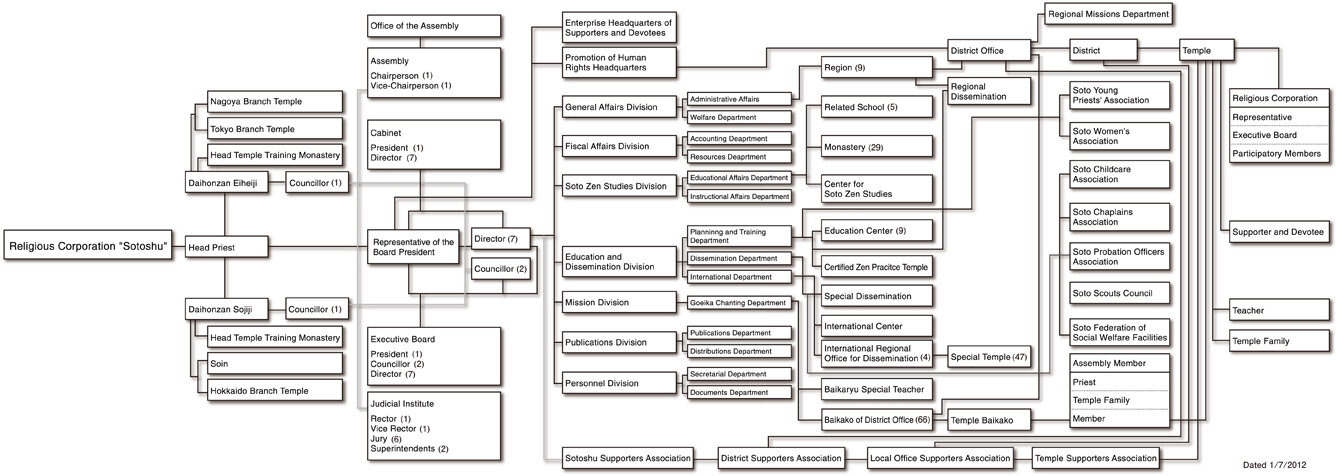
The Sōtō-shū organisation has an elaborate organisation.[lower-alpha 1] It consists of about 15,000 temples. There are circa 30 training centers, where Sōtō monks can train to become an oshō or priest and run their own temple.[web 4]
Head and parliament
Sōtō-shu has a centralised organisation, run by a head:
Sōtō-shū is a democratic organization with a head (called 宗務総長 Shūmusōchō) that is elected by a parliament. The parliament in turn consist of 72 priests that are elected in 36 districts throughout Japan, 2 from each district. The Shūmusōchō selects a cabinet that consists of him and seven other priests who together govern the organization. It is commonly believed that the Kanchō, who is either the head of Eiheiji or Sōjiji, the two head temples, is the boss of Sōtō-shū. This is not the case. The Kanchō has only representational functions; the real power lies with the Shūmusōchō and his cabinet.[web 4]
Temples
Contemporary Sōtō-shū has four classes of temples:[43]
- Honzan (本山), head temples, namely Eihei-ji and Sōji-ji;
- Kakuchi, teaching monasteries, where at least once a year an ango (ninety-day retreat) takes place;
- Hōchi, dharma temples;
- Jun hōchi, ordinary temples.
While Eihei-ji owes its existence to Dōgen, throughout history this head temple has had significantly fewer sub-temple affiliates than the Sōji-ji. During the Tokugawa period, Eiheiji had approximately 1,300 affiliate temples compared to Sōji-ji's 16,200. Furthermore, out of the more than 14,000 temples of the Sōtō sect today, 13,850 of those identify themselves as affiliates of Sōji-ji. Additionally, most of the some 148 temples that are affiliates of Eiheiji today are only minor temples located in Hokkaido—founded during a period of colonization during the Meiji period. Therefore, it is often said that Eiheiji is a head temple only in the sense that it is head of all Sōtō dharma lineages.[1]
See also
Notes
- ↑ See Sōtō-shū organisation for an organogram
References
Book references
- ↑ 1.0 1.1 Bodiford 1993.
- ↑ Slater 1997, p. 218-219.
- ↑ 3.0 3.1 3.2 Buswell & Lopez 2014, s.v. Caodong zong.
- ↑ Foulk & Year unknown.
- ↑ Dumoulin 2005b, p. 124.
- ↑ Dumoulin 2005b, p. 128.
- ↑ 7.0 7.1 7.2 Dumoulin 2005b, p. 125.
- ↑ Buswell & Lopez 2014, s.v. Darumashū.
- ↑ 9.0 9.1 9.2 Dumoulin 2005b, p. 122.
- ↑ Yampolsky 1985, pp. 4–5.
- ↑ Dumoulin 2005b, p. 135.
- ↑ Faure 1986, p. 47.
- ↑ 13.0 13.1 Dumoulin 2005b, p. 139.
- ↑ Dumoulin 2005b, p. 140.
- ↑ 15.0 15.1 15.2 Dumoulin 2005b, p. 142.
- ↑ 16.0 16.1 Faure 1986, p. 7.
- ↑ Faure 1986, p. 8.
- ↑ Prebish & Heine 2003.
- ↑ Bodiford 1993, p. 81.
- ↑ Slater 1997.
- ↑ 21.0 21.1 21.2 Dumoulin 2005b, p. 207.
- ↑ Dumoulin 2005b, p. 208.
- ↑ Dumoulin 2005b, pp. 208–209.
- ↑ 24.0 24.1 Mohr 1994, p. 353.
- ↑ Snelling 1987.
- ↑ 26.0 26.1 Dumoulin 2005b.
- ↑ Mohr 1994, p. 353-354.
- ↑ 28.0 28.1 28.2 28.3 Bodiford 1991, p. 450.
- ↑ Tetsuo 2003.
- ↑ Bodiford 1999.
- ↑ Lachs 1999.
- ↑ Heine & Wright 2000, p. 245.
- ↑ 33.0 33.1 33.2 33.3 33.4 33.5 33.6 33.7 Bodiford 2006.
- ↑ 34.0 34.1 Victoria 2006.
- ↑ Victoria 2010.
- ↑ McMahan 2008.
- ↑ Sharf 1993.
- ↑ Ford, p. 79.
- ↑ Hall 1998, p. 625.
- ↑ Harvey, 165
- ↑ Coleman, 53
- ↑ Lu, 118
- ↑ Bodiford 2008, p. 330, note 29.
Web-references
- ↑ Foulk, T. Griffith. "Soto School Scriptures for Daily Services and Practice (Sōtōshū nikka gongyō seiten)". Ho Center for Buddhist Studies at Stanford. Soto Zen Text Project. Archived from the original on April 8, 2015. Retrieved April 4, 2015.
- ↑ Soto Zen Text Project. "Zazengi translation". Stanford University. Archived from the original on 2010-06-23. Retrieved 2008-03-26.
- ↑ Soto Zen Text Project. "Fukan Zazengi". Stanford University. Retrieved 2008-03-26.
- ↑ 4.0 4.1 Muho Noelke: About the meaning of the vertical and horizontal structure of the sangha
Sources
- Anderson, Reb (2001). Being Upright: Zen Meditation and the Bodhisattva Precepts. Rodmell Press. ISBN 0-9627138-9-9. OCLC 44414111.
- Bodiford, William M. (1991), Dharma Transmission in Soto Zen. Manzan Dohaku's Reform Movement. In: Monumenta Nipponica, Vol.46, No.4 (Winter, 1991), pp 423-451
- Bodiford, William M. (1992), Zen in the Art of Funerals: Ritual Salvation in Japanese Buddhism. In: 'History of Religions' 32, no. 2 (1992): 150
- Bodiford, William M. (1993). Sōtō Zen in Medieval Japan. University of Hawaii Press. ISBN 0-8248-1482-7.
- Bodiford, William M. (2006). "Remembering Dōgen: Eiheiji and Dōgen Hagiography". Society for Japanese Studies. 32 (1): 1–21. doi:10.1353/jjs.2006.0003. ISSN 1549-4721.
- Bodiford, William (2006b), Koan practice. In: John Daido Loori (ed)(2006), "Sitting with koans. Essential writings on the practice of Zen koan introspection", Boston: Wisdom Publications
- Bodiford, William M. (2008), Dharma Transmission in Theory and Practice. In: Zen Ritual: Studies of Zen Buddhist Theory in Practice (PDF), Oxford University Press[permanent dead link]
 Buswell, Robert E.; Lopez, Donald S. (2014), The Princeton Dictionary of Buddhism, Princeton University
- Coleman, James William (2001). The New Buddhism: The Western Transformation of an Ancient Tradition. Oxford University Press. ISBN 0-19-515241-7. OCLC 48932003.
- Dōgen, Eihei (1971). Primer of Sōtō Zen: A Translation of Dōgen's Shōbōgenzō Zuimonki. Masunaga, R. (trans). (East West Center Book) University of Hawaii Press. ISBN 0-8248-0357-4.
- Dumoulin, Heinrich (2005b), Zen Buddhism: A History. Volume 2: Japan, World Wisdom Books, ISBN 978-0-941532-90-7
- Faure, Bernard (1986). Visions of Power: Imagining Medieval Japanese Buddhism. Princeton University Press. ISBN 0-691-02941-5. OCLC 44599484.
- Ford, James Ishmael (2006). Zen Master Who?: A Guide to the People and Stories of Zen. Wisdom Publications. ISBN 0-86171-509-8. OCLC 70174891.
- Foulk, T. Griffith (n.d.), History of the Soto Zen School
- Hall, John Whitney (1988). The Cambridge History of Japan. Cambridge University Press. ISBN 0-521-22352-0. OCLC 17483588.
- Harvey, Peter (1990). An Introduction to Buddhism: Teachings, History, and Practices. Cambridge University Press. ISBN 0-521-31333-3. OCLC 19589186.
- Heine, Steven; Wright, Dale S. (2000). The Koan: Texts and Contexts in Zen Buddhism. Oxford University Press. ISBN 0-19-511748-4. OCLC 41090651.
- Heine, Steven (2004). "Kōans In The Dōgen Tradition: How and Why Dōgen Does What He Does With Kōans". Philosophy East & West. University of Hawaii Press. 54 (1): 1–19, 19p. doi:10.1353/pew.2003.0052. ISSN 0031-8221. OCLC 1485347.
- Juergensmeyer, Mark (2006). The Oxford Handbook of Global Religions. Oxford University Press. ISBN 0-19-513798-1. OCLC 64084086.
- Kay, David N. (2004). Tibetan and Zen Buddhism in Britain: Transplantation, Development and Adaptation. Routledge. ISBN 0-415-29765-6. OCLC 51315294.
- Koho, K.C. (2000) Sōtō Zen: An Introduction to the Thought of the Serene Reflection Meditation School of Buddhism, Shasta Abbey Press, ISBN 0-930066-09-X
- Lachs, Stuart (1999), Means of Authorization: Establishing Hierarchy in Ch'an /Zen Buddhism in America
- Leighton, Taigen Daniel (2000). Cultivating the Empty Field: The Silent Illumination of Zen Master Hongzhi. Tuttle Publishing. ISBN 0-8048-3240-4. OCLC 43978646.
- Loori, John Daido (1996). The Heart of Being: Moral and Ethical Teachings of Zen Buddhism. Tuttle Publishing. ISBN 0-8048-3078-9. OCLC 42855782.
- Lu, David J. (1997). Japan: A Documentary History. M.E. Sharpe. ISBN 1-56324-907-3. OCLC 34876074.
- Masunaga, Reihō (1969) [1968]. Sekai hyakka jiten 世界百科事典. 13. Heibonsha.
- McMahan, David L. (2008), The Making of Buddhist Modernism, Oxford University Press, ISBN 978-0-19-518327-6
- Mohr, Michel (1994), Zen Buddhism during the Tokugawa period: The challenge to go beyond sectarian consciousness. In: Japanese Journal of Religious Studies, vol. 21 no. 4, December 1994, pp. 341–72 (PDF)
- O'Halloran, Maura (2007). Pure Heart, Enlightened Mind: The Life and Letters of an Irish Zen Saint. Wisdom Publications. ISBN 0-86171-283-8. OCLC 83977483.
- Oldmeadow, Harry (2004). Journeys East: 20th Century Western Encounters with Eastern Religious Traditions. World Wisdom, Inc. p. 528. ISBN 0-941532-57-7. OCLC 54843891.
- Prebish, Charles S.; Heine, Steven (2003). Buddhism in the Modern World: Adaptations of an Ancient Tradition. Oxford University Press. ISBN 0-19-514698-0. OCLC 50730942.
- Senauke, Hozan Alan (April 2006). "A Long and Winding Road: Sōtō Zen Training in America". Teaching Theology & Religion. Blackwell Publishers. 9 (2): 127–132, 6p. doi:10.1111/j.1467-9647.2006.00274.x. ISSN 1467-9647. OCLC 38912788.
- Sharf, Robert H. (August 1993), "The Zen of Japanese Nationalism", History of Religions, 33 (1): 1–43
- Shimano, Eido Tai (1996), Dai Bosatsu Mandala. A Portrait of Soen Nakagawa. In: Kazuaki Tanahashi & Roko Sherry Chayat (1996), Endless Vow. The Zen Path of Soen Nakagawa, Boston, Massachusetts: Shambhala Publications, Inc
- Slater, Peter (1977). Religion and Culture in Canada: Essays by Members of the Canadian Society. Wilfrid Laurier University Press. ISBN 0-919812-01-5. OCLC 2157551.
- Snelling, John (1987), The Buddhist handbook. A Complete Guide to Buddhist Teaching and Practice, London: Century Paperbacks
- Spuler, Michelle (2003). Developments in Australian Buddhism: Facets of the Diamond. Routledge. ISBN 0-7007-1582-7. OCLC 49952207.
- Victoria, Brian Daizen (2006), Zen at war (Second ed.), Lanham e.a.: Rowman & Littlefield Publishers, Inc.
- Victoria, Brian Daizen (2010), "The "Negative Side" of D. T. Suzuki's Relationship to War" (PDF), The Eastern Buddhist, 41 (2): 97–138
- Warner, Brad (2007). Sit Down and Shut Up: Punk Rock Commentaries on Buddha, God, Truth, Sex, Death, & Dōgen's Treasury of the Right Dharma Eye, New World Library, ISBN 978-1-57731-559-9
- Williams, D. R. (2004) The Other Side of Zen: A Social History of Sōtō Zen Buddhism in Tokugawa Japan (Buddhisms: A Princeton University Press Series), Princeton University Press, ISBN 0-691-11928-7
- Yampolsky, Philip B. (1985). The Zen Master Hakuin. Columbia University Press. ISBN 0-231-06041-6. OCLC 185642013.


External links
Japan
- Sōtō Zen International Official homepage of the Sōtō school of Zen.
Europe
- Order of the Prairie Wind An independent order of ordained Sōtō Zen Buddhist priests founded by Rev. Nonin Chowaney.
- The Norwegian Sōtō Zen Buddhist Order. (Defaults to Norwegian text. English text selectable.)
- The International Zen Association Founded by Master Taisen Deshimaru in France for Europe.
- The IZA in the UK IZAUK is an affiliate of the International Zen Association.
USA
- The Order of Buddhist Contemplatives The Order of Buddhist contemplatives founded by Rev. Master P.T.N.H. Houn Jiyu-Kennett.
- San Francisco Zen Center One of the largest American Sōtō Zen centers, founded by Shunryū Suzuki Roshi and his American students in 1962. SF Zen Center's Tassajara Zen Mountain Center was the first Sōtō Zen training monastery established in North America.
- Shasta Abbey Buddhist Monastery Official homepage of the Sōtō Zen Buddhist Abbey near Mount Shasta, CA.
- Sōtō Zen Buddhist Association
History and academic studies
- thezensite: Dogen studies Collection of academic articles and studies on Dōgen
| This article includes content from Sōtō on Wikipedia (view authors). License under CC BY-SA 3.0. | 
|